PRESS STATEMENT · FOR IMMEDIATE RELEASE
On the occasion of the World Day Against Trafficking in Persons — 30 July 2026
Accra, 29 July 2026 — Ahead of the World Day Against Trafficking in Persons, marked worldwide on 30 July, Challenging Heights wishes to bring to the attention of the nation, and of the world, the scale of human trafficking that continues to rob our children and young people of their childhood, their dignity and their freedom.
First, we are compelled to caution the Ghanaian public that modern slavery is real, that it exists among us, and that anyone can become a victim. Too many of our compatriots remain in denial, believing that slavery ended long ago, or that it happens only somewhere else. It does not.
According to the Global Slavery Index, an estimated fifty million (50 million) people were living in modern slavery on any given day, over seven million (7 million) of them in Africa alone. The International Labour Organisation estimates that forced labour generates illegal profits in excess of two hundred and thirty-six billion United States dollars (US$236 billion) every year. At Challenging Heights, we are daily witnesses to this reality, to the innocent children, women and men who have fallen victim to this crime.
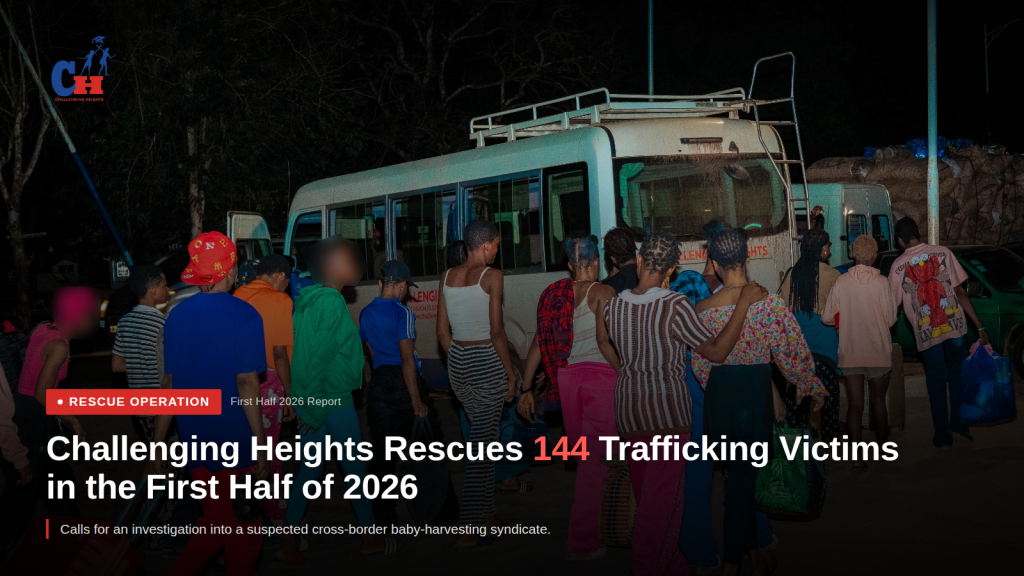
In the first half of this year alone, Challenging Heights, working with the Anti-Human Trafficking Unit (AHTU) of the Ghana Police Service and other partners, has supported the rescue of one hundred and forty-four (144) victims of trafficking and modern slavery. Of these, forty-two (42) are children rescued from forced labour on the Lake Volta — nineteen (19) boys and twenty-three (23) girls. A further one hundred and two (102) victims are Nigerian nationals — sixty (60) girls and forty-two (42) boys — all between the ages of thirteen (13) and twenty-nine (29).
The forms of exploitation are as varied as they are cruel. Some of the children were used for fishing on the Lake Volta. Others were forced into cyber-criminal activities. The girls trafficked from Nigeria were forced into dehumanising commercial sexual exploitation, including in mining communities such as Obuasi and in the Upper East Region.
Typically, these young women are deceived with false promises of decent work in Ghana, in groceries, restaurants and supermarkets, only to be trapped, exploited and abused on arrival. The accounts of these survivors are harrowing, particularly those of the girls trafficked from Nigeria. One teenage girl, who had been in Ghana for about eleven (11) months, was carrying a two-week-old baby at the time of her rescue. She told Challenging Heights that the woman who held her had done everything possible to sell her baby.
Most disturbing of all, several survivors have given consistent accounts of what they describe as an organised baby-harvesting and baby-selling operation — in which young Nigerian women are brought into Ghana, made pregnant, and held until they deliver babies who are then sold. Challenging Heights has not independently verified these accounts and does not present them as proven fact; but we consider them grave, credible and consistent enough to demand an immediate and thorough investigation by the security agencies.
Challenging Heights commends the Anti-Human Trafficking Unit of the Ghana Police Service, and the Human Trafficking Secretariat, for their courage and commitment in the fight against trafficking in Ghana, often under severe resource constraints. It is on the strength of this partnership that these rescues were possible.
On this World Day Against Trafficking in Persons, Challenging Heights therefore makes the
following calls:
● To the security agencies: mount a massive, coordinated investigative operation to unravel
the suspected baby-harvesting and baby-selling syndicate, rescue any victims still held, and
bring the perpetrators to justice under the Human Trafficking Act, 2005 (Act 694).
● To the Government of Ghana: adequately resource the agencies mandated to fight
trafficking. Challenging Heights reiterates its call for a minimum allocation of GH₵20 million
to properly equip these agencies to prevent, investigate and prosecute trafficking.
● To the Government of Nigeria, and to Nigerian civil society and citizens: mount vigorous
public-awareness campaigns to warn young Nigerians — especially young women — against
deceptive offers of work abroad, and strengthen cross-border cooperation to dismantle
these networks.
● To the Ghanaian public: be vigilant, and report any suspected case of trafficking or child
exploitation to the police without delay.
“Every one of these children and young people has a name, a family and a future that trafficking tried to steal,” said James Kofi Annan, Founder and Executive Director of Challenging Heights. “The accounts we have heard this year, of a teenage girl whose baby a trafficker tried to sell, of young women brought here to be made pregnant so that their children can be traded, should shake the conscience of every Ghanaian and every Nigerian. We cannot look away. We are calling for action, not tomorrow, but now.”
Over the past two decades, Challenging Heights has supported the rescue of nearly three thousand (3,000) children and young people from trafficking and exploitation, and has provided long-term rehabilitation, reintegration and livelihood support to thousands more. We remain committed to this work, and to a Ghana and a West Africa in which no child is bought, sold or enslaved.